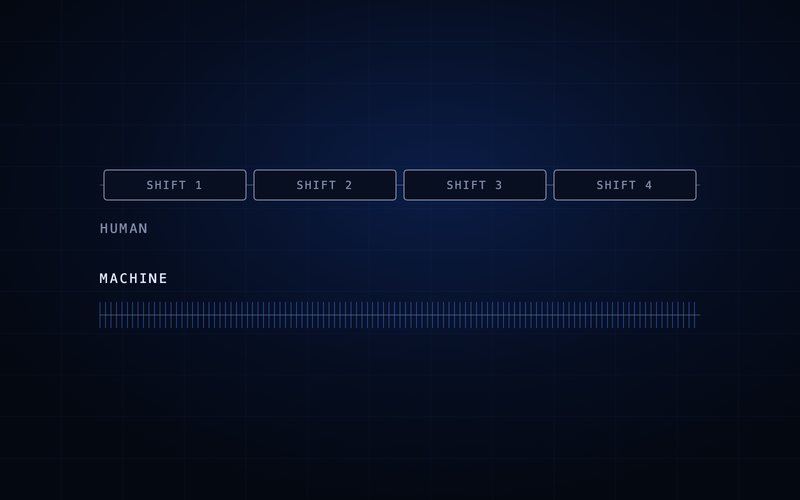
Section 01The Speed Problem: When Attackers Operate Faster Than Humans
There is a fundamental asymmetry at the heart of modern cybersecurity. Attackers operate with the full force of AI automation - scanning for vulnerabilities, crafting personalized attacks, adapting malware in real time, and executing multi-stage intrusions across entire enterprise environments in minutes. Defenders, meanwhile, still rely largely on human analysts who must triage alerts, pivot between dashboards, correlate signals across tools, approve response actions, and make decisions - all at biological speed.
This asymmetry is not theoretical. The State of AI Cybersecurity 2026 report, drawing on data from 1,800+ security professionals, found that 73% report AI-powered threats already targeting their organizations. Hyper-personalized phishing tops the list of concerns at 50%, followed by automated vulnerability scanning and exploit chaining at 45%, and adaptive malware at 40%. What defines these threats is coordination: attackers now use AI to orchestrate full attack chains from reconnaissance through data exfiltration with minimal human involvement.
The adversarial calculus has changed irreversibly. When attackers automate every phase of an attack chain - and AI agents can be turned against their owners through a single prompt injection or tool-misuse exploit - the window for reactive, human-speed security has effectively closed. 2026 has been called "the Year of the Defender" - but only for organisations that embrace autonomous AI defence. Those that don't will face a widening gap that no amount of headcount or tool investment can close.
Section 02What Autonomous Cyber Defence Actually Means
"Autonomous" is one of the most overloaded words in cybersecurity marketing. Every vendor claims automation. Most mean scheduled scripts, pre-written playbooks, and rule-based alerts that still require human approval at every meaningful decision point. True autonomous cyber defence is categorically different.
Autonomous cyber defence means a security platform that can, without human instruction at each step:
Detect Continuously
Monitor all security domains - endpoints, networks, cloud, identity, email, OT - in real time without gaps, shift changes, or alert queue backlogs. Every event, every anomaly, across every layer, watched simultaneously.
Investigate Independently
When threat signals emerge, correlate them across all domains automatically. Reconstruct the attack chain, identify affected assets, map to MITRE ATT&CK techniques, assess blast radius - all without an analyst opening a ticket.
Reason Contextually
Apply judgment - not rules. Weight asset criticality, regulatory context, attack confidence, user risk history, and environmental topology to determine the most appropriate response.
Respond Immediately
Execute containment within seconds of threat confirmation - isolating hosts, revoking tokens, blocking IPs, updating firewall rules, creating incident records - without waiting for human approval gates.
Explain Clearly
Translate machine-speed intelligence into human-readable incident narratives. Give CISOs the executive picture, SOC analysts the investigation detail, and threat hunters the hypothesis chain.
Learn Continuously
Every incident, investigation, and response becomes a training signal. The platform's understanding of your environment grows more precise over time, moving from reactive detection toward predictive defence.
The crucial distinction: Automation executes a predefined action when a rule fires. Autonomy reasons about a situation and determines the best action from context. A SOAR playbook is automation. A security platform that evaluates an incident across 40 data dimensions and decides whether to isolate a host, revoke a token, or escalate to a human - and explains why it made that call - is autonomy.
Section 03The Modern Attack Chain - and Where Autonomous Defence Intercepts It
To understand why autonomous defence is necessary, look at how modern AI-powered attacks actually operate. A sophisticated adversary in 2026 doesn't just launch malware and wait. They execute a coordinated kill chain across multiple domains simultaneously, moving faster than human-speed detection can track - and adapting in real time to any defensive response they encounter.
Modern AI-Powered Attack Chain
Phase 1
Recon
AI scans attack surface, maps identities, finds exposed assets
AI-automatedPhase 2
Initial Access
Hyper-personalized phishing or credential stuffing at scale
AI-generatedPhase 3
Privilege Esc.
Exploits identity gaps, escalates via stolen tokens or misconfig
Machine-speedIntercept
Sphere Detects
UEBA flags identity anomaly; LLM correlates recon + phishing signals
AutonomousPhase 4
Lateral Move
Moves through network, compromises adjacent systems quietly
AdaptiveResponse
Sphere Acts
Isolates compromised hosts, revokes tokens - in under 60 seconds
Sub-60sThe attack chain above illustrates why speed is existential. In a human-operated SOC, the average time between an analyst seeing an alert and a containment action being approved and executed is measured in hours. By then, an AI-powered adversary has already moved laterally across multiple systems, established persistence, and begun staging data for exfiltration. Autonomous defence collapses that window - intercepting the chain before it reaches its most damaging phases.
Section 04Human-Dependent vs. Autonomous Security: The Operational Reality
The case for autonomous defence isn't that humans are inadequate - it's that the volume, speed, and sophistication of modern threats have simply exceeded what human-scale security operations can handle.
Traditional Human-Dependent Security
Autonomous Cyber Defence
Section 05Agentic AI: The Architecture That Makes Autonomy Possible
Autonomous cyber defence requires more than a single AI model. It requires an architecture where multiple specialized AI agents operate simultaneously across different security domains, each pursuing its own monitoring objectives while contributing to a shared understanding of the environment. This is agentic AI - and it represents a fundamental shift from the "single model, single query" approach of earlier AI security tools.
In an agentic architecture, each agent is a specialist: one monitors endpoint behaviour patterns, another tracks network traffic anomalies, a third watches identity and access patterns for signs of credential compromise, a fourth monitors cloud workload behaviour. Each agent operates continuously and independently - but all agents report to a central reasoning layer that synthesizes their signals into a coherent picture.
The central reasoning layer - in Spharaka's case, the SAGE AI Model - is what transforms raw multi-domain telemetry into actionable intelligence. It receives signals from all agents simultaneously, correlates them into attack narratives, reasons about severity and intent, and orchestrates the appropriate response. This is the difference between "we detected anomalies in three systems" and "we identified a coordinated credential theft campaign targeting your finance department, traced it to initial access via a compromised vendor account, and contained it by revoking the token and isolating three affected endpoints."
The move from AI-assisted to AI-led security operations is a fundamental shift in how organisations defend themselves. Rather than augmenting human analysts with AI tools, it positions AI as the primary operator, with humans providing strategic direction and handling the complex judgements.
The direction of industry research in 2026
Section 06The Evolution of Cyber Defence: From Signatures to Autonomy
Autonomous cyber defence didn't emerge overnight. It is the culmination of five generations of security technology evolution - each generation solving the limitations of the last, and each ultimately reaching its own ceiling.
Signature-Based Detection
Antivirus and IDS matching known patterns. Effective against known threats, blind to everything else.
SIEM & Log Correlation
Centralized log collection with rule-based correlation. Better visibility, but massive alert noise and human-dependent investigation.
SOAR & Playbook Automation
Pre-written response playbooks triggered by rules. Faster for known scenarios, rigid against novel attacks.
XDR & Cross-Layer Detection
Telemetry correlation across endpoints, networks, cloud. Better context, but still human-gated investigation and response.
Autonomous Cyber Defence
AI-powered platforms that detect, investigate, reason, respond, and learn - continuously, autonomously, at machine speed. The Spharaka Sphere™ generation.
Section 07Spharaka Sphere™: Autonomous Cyber Defence in Practice
Spharaka Sphere™, powered by AuraXP™ Agentic AI Native Technology, is purpose-built to deliver genuine autonomous cyber defence - not a rebadged SIEM or an XDR with an AI chatbot bolted on, but a platform designed from the ground up around the principle that security must operate at machine speed, with machine intelligence, across every domain simultaneously.
Spharaka Sphere™
Autonomous Cyber Defence Platform
How Sphere delivers genuine autonomous defence through AuraXP™ and the SAGE AI Model.
Autonomous Detection
40+ AI agents monitoring endpoints, networks, cloud, identity, email, and OT simultaneously.
Autonomous Investigation
Full attack chain reconstruction without human direction - complete with evidence mapping.
SAGE AI Model Reasoning
SAGE AI Model synthesizes multi-domain signals into unified threat narratives and response decisions.
Autonomous Response
Host isolation, IP blocking, token revocation, firewall updates - executed in under 60 seconds.
Natural Language Narratives
Every incident explained in plain language - role-specific for CISOs, analysts, and hunters.
Continuous Learning
Organizational memory that improves baseline understanding and threat detection over time.
Section 08AI vs AI: The New Cyber Warfare Paradigm
The security industry is entering an era best described as AI vs AI cyber warfare. Attackers deploy autonomous AI agents that scan, exploit, adapt, and persist without human direction. Defenders must respond with autonomous AI platforms that detect, investigate, reason, and contain at the same speed. The battlefield has shifted from human vs human to machine vs machine.
In this paradigm, the competitive advantage goes to the platform with better intelligence, better reasoning, and faster execution. The SAGE AI Model, trained on 16 million real-world security events and continuously updated with live threat intelligence, represents one of the most deeply specialized security reasoning engines available today. Combined with AuraXP's multi-agent architecture, it creates a defence capability that matches and exceeds the sophistication of AI-powered attackers.
The uncomfortable reality: Organisations that continue to rely on human-speed security operations in an era of machine-speed attacks are not just falling behind - they are structurally indefensible. The gap between AI-powered attack speed and human response speed will only widen. Autonomous cyber defence is not an upgrade. It is a prerequisite for survival.
Section 09Who Needs Autonomous Cyber Defence Most?
Every industry faces increasing cyber risk in 2026, but autonomous cyber defence is most critical for sectors with high data sensitivity, complex attack surfaces, and regulatory obligations. These sectors face the most sophisticated and persistent adversaries, carry the highest cost of breach, and operate the most complex, multi-domain digital environments where manual security operations simply cannot scale.
Section 10The Verdict: Autonomous Defence Is Not Optional
The threat landscape of 2026 has made one thing unambiguous: human-dependent security operations cannot keep pace with AI-powered attacks. The speed gap, the complexity gap, and the scale gap between modern attackers and traditional defenders will only widen.
Autonomous cyber defence - powered by agentic AI architectures, purpose-built security LLMs, and multi-domain continuous monitoring - is the only approach that matches the threat. Not as a complement to human analysts, but as the primary operating model with humans providing strategic direction and complex judgment.
Spharaka Sphere™, powered by AuraXP™ and the SAGE AI Model, represents this future today. A single unified platform that detects, investigates, reasons, responds, explains, and learns - continuously, autonomously, at machine speed.
The future of security is not faster humans. It is intelligent machines governed by humans. That future is already here.