Defining the term, and what it is not
Autonomous threat hunting is the continuous, platform-driven generation and validation of hunt hypotheses against an organisation's full telemetry set, executed by an agent fabric and reviewed by humans at the point of decision rather than at the point of query authorship.
It is easiest to define by contrast with the models it replaces:
- Ad-hoc hunting: a hunter follows a hunch or a headline, writes queries by hand, and closes the loop when curiosity or time runs out. Coverage is whatever one person got to this week.
- Hypothesis-driven hunting: a structured programme where hunters formally document a hypothesis, test it, and record the outcome. More rigorous than ad-hoc, still bottlenecked by how many hypotheses a small team can author and test.
- Scheduled hunting: a fixed cadence, monthly or quarterly, running a known checklist of techniques. Predictable, but static. It does not adapt when a new CVE or a new CTI advisory changes what actually matters this week.
- Autonomous hunting: hypotheses are generated continuously from CTI, environmental change, and prior findings, and executed by the platform against live telemetry. Humans review outcomes, not raw query results.
What 'autonomous' actually means here
The word invites two wrong readings. It does not mean a library of saved batch scripts running on a cron schedule. It also does not mean the platform decides on its own to take containment action without a human in the loop.
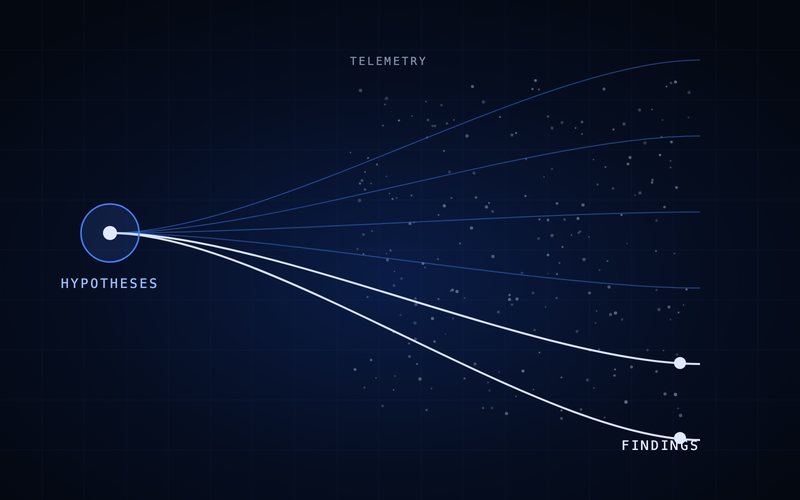
What it means, precisely, is continuous hypothesis generation and validation across the data plane. The platform ingests CTI, advisories, and environmental change signals, converts them into testable hypotheses expressed in the organisation's own telemetry schema, executes the query and correlation logic needed to test each one, and evaluates the result with enough context to say whether it is a finding, a non-finding, or something that needs a human eye.
The distinction matters because a batch of saved searches degrades the moment the environment changes. Continuous hypothesis generation does not, because it is regenerating hypotheses from current inputs rather than replaying old ones.
The shift from query authorship to hypothesis review
The most concrete operational change is where a hunter spends their attention. In the classical model, a hunter's day is dominated by writing and debugging queries: getting the syntax right, joining the right tables, filtering noise.
In the autonomous model, the platform authors and executes the query. The hunter's day is dominated by reviewing hypotheses and their outcomes: is this hypothesis worth pursuing, is this finding real, does this finding merit a new detection rule, does this non-finding tell us anything about coverage.
This is a genuine change in job content, not a cosmetic one. It moves hunters from being query engineers to being judgement-and-context specialists, which is the part of the job that does not commoditise.
Prerequisites before autonomous hunting works
Autonomous hunting is not a bolt-on. It requires infrastructure that most organisations underinvest in even when their detection stack is mature.
- Unified telemetry: hunts that only see endpoint data, or only see network data, miss the techniques that live in the gaps. The platform needs a normalised view across endpoint, identity, network, and cloud control-plane logs.
- A meaningful retention window: many hunt hypotheses look back weeks or months for early indicators of a slow-burn intrusion. Thirty days of hot storage is not enough for most credible hunt patterns.
- CTI enrichment: hypotheses are only as good as the intelligence feeding them. Structured CTI, mapped to your actual asset and identity inventory, is what turns a generic advisory into a testable, environment-specific hypothesis.
- An agent fabric: something has to execute the correlation logic at scale, across data sources, on a continuous basis, without a human queuing each query by hand. This is the execution layer that makes the previous three prerequisites actionable.
Typical hunt patterns
In practice, most autonomous hunt programmes converge on a recurring set of technique families, because these are where detection coverage is thinnest and dwell time is longest.
- Living-off-the-land: abuse of legitimate admin tools such as PowerShell, WMI, or PsExec in ways that evade signature-based detection but leave a distinct behavioural signature.
- Persistence: scheduled tasks, registry run keys, service creation, and identity-based persistence such as new OAuth grants or federation trust changes.
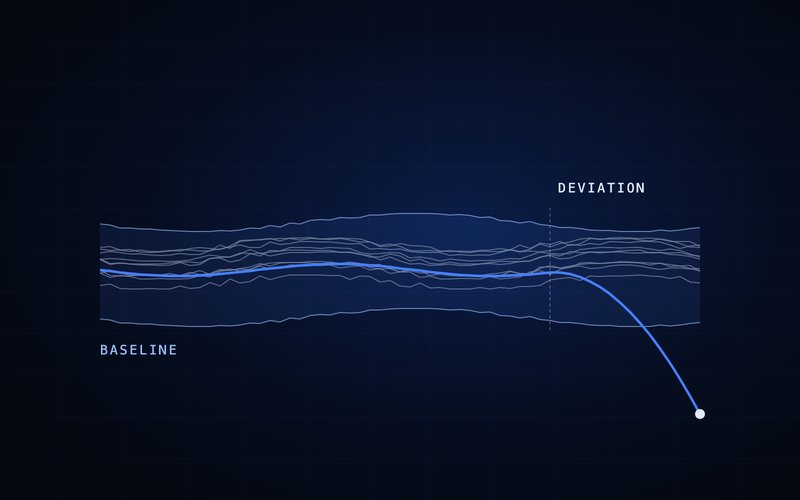
- Lateral movement: credential reuse, unusual authentication paths, and service account behaviour that deviates from historical baselines.
- Exfiltration staging: unusual archive creation, large outbound transfers to uncommon destinations, and use of sanctioned cloud storage as a covert channel.
Closing the loop with detection engineering
A hunt programme that never feeds detection engineering is running the same investigation over and over. Every confirmed finding, and every well-reasoned near-miss, is a candidate for a permanent detection rule.
The mature pattern is a formal promotion path: a hunt hypothesis that produces a true positive gets converted into a standing detection, so the next occurrence is caught automatically rather than rediscovered by another hunt cycle. This is what turns a hunt programme from a cost centre into a detection content pipeline.
Measuring hunt programme value
Threat hunting has historically resisted measurement, which is one reason it is often the first budget line cut. Autonomous hunting produces the operational data to fix that.
- Findings per week: raw hypothesis throughput, and a leading indicator of whether the programme is actually running at the cadence the tooling promises.
- Converted-to-detection rate: the percentage of confirmed findings that result in a new or tuned detection rule. A low rate suggests findings are being filed and forgotten.
- Dwell-time reduction: the clearest lagging indicator. If hunts are catching techniques earlier in the kill chain, mean time to detection on subsequent incidents should trend down.
- Coverage against MITRE ATT&CK: for each relevant technique, when it was last hunted, in what scope, and with what confidence. This is the artefact auditors and boards increasingly ask for directly.
Where hunt programmes go wrong
Autonomous execution removes the throughput bottleneck, but it introduces new failure modes if the programme is not designed with discipline.
- Drowning in low-severity findings: a platform that generates hundreds of low-confidence hypotheses without prioritisation just moves the triage burden rather than removing it.
- Unclear ownership: if no named role is accountable for reviewing hunt outcomes daily, findings sit unreviewed and the programme's value never materialises.
- No promotion path: without a formal route from confirmed finding to standing detection, the same technique gets rediscovered on every hunt cycle instead of being closed permanently.
- Treating coverage as a vanity metric: hunting a technique once and marking it done is not coverage if the environment has changed materially since.
How Spharaka delivers this
Spharaka's Autonomous Threat Hunting capability is built on three components working together. SAGE generates hunt hypotheses from CTI enrichment, advisories, and environmental change, and reasons over the results to distinguish findings that matter from noise. AuraXP agents execute the correlation logic across endpoint, identity, network, and cloud telemetry without waiting for a human to queue each query. The Sphere data plane provides the unified, retained telemetry base that makes both possible, so hunts are not limited to whatever one log source happens to be indexed.
The output is a natural-language hunt report with MITRE ATT&CK mapping and a documented promotion path into detection engineering. Human hunters remain the reviewing and authorising authority for every finding of consequence; the platform's job is to make sure they are reviewing judgement calls, not writing queries.
Frequently asked questions
Does autonomous hunting replace SIEM search?
No. It replaces the manual pattern of a human writing a query, reading the result, and writing another query. The SIEM or data lake is still where the evidence lives; the platform is what generates and tests hypotheses against it continuously.
How does this differ from detection engineering?
Detection engineering builds rules that fire continuously on known patterns. Threat hunting looks for evidence of things you are not currently detecting. Autonomous hunting improves throughput on the hunting side, and a well-run programme feeds confirmed findings back into detection engineering as new rules.
Does it work without CTI?
It works better with CTI, and remains functional without it. CTI is a rich source of hypotheses because it points at specific, currently active techniques. In its absence, the platform can still generate hypotheses from environmental changes, prior findings, and known advisories.
What is the minimum retention window needed?
There is no universal number, but many credible hunt hypotheses, particularly for persistence and slow lateral movement, require looking back weeks to months. Retention windows built only for compliance minimums are usually too short for hunting.
Does autonomous hunting eliminate the need for skilled hunters?
No. It removes the mechanical work of query authorship and execution so skilled hunters can spend their time on judgement calls: which findings matter, which hypotheses deserve deeper investigation, and which confirmed findings should become permanent detections.