Attacker's Monthly Cost
$20The cost of a basic AI subscription. No team. No expertise. No infrastructure.
SMB Breach Cost - One Incident
$120K+The minimum damage from a single successful attack on a small business.
Spend $20. Cause $120,000 in damage. This is not a technology problem. It is an economics problem. And the economics have permanently shifted.
01 - The ShiftThe Day AI Changed the Economics of Cybercrime
For most of cybersecurity's history, the attacker faced a cost structure not entirely different from the defender. Mounting a sophisticated attack required expertise, programming knowledge, operational security practices, understanding of network protocols. It required infrastructure, servers to route traffic, tools to maintain access. It required time: reconnaissance, scripting, testing, execution.
AI has eliminated all three requirements simultaneously. Generative AI tools that cost $20/month can now produce flawless phishing emails, write functional exploit code, automate target reconnaissance, and help attackers identify vulnerabilities in target environments with no expertise required beyond the ability to type a prompt. The underground market for offensive AI tools has matured rapidly; what was state-of-the-art nation-state tradecraft in 2022 is now a commodity subscription service in 2026.
The result is a structural inversion of the attacker-defender economics. Attackers now operate at near-zero marginal cost per target. Each additional organisation they attack costs almost nothing beyond the initial subscription. Defenders, meanwhile, face a fixed cost structure that scales with the number of security tools, the size of the analyst team, and the value of the assets at risk, none of which has gotten cheaper.
02 - What $20 Actually BuysThe Full Attack Surface, Automated
To understand why the $20 figure is so significant, it helps to be specific about what a threat actor can actually accomplish with a basic AI subscription and the publicly available offensive tooling that now surrounds it.
Convincing Phishing at Industrial Scale
AI-generated phishing emails are grammatically flawless, contextually personalised, and adapted to the target's writing style, role, and recent activity. Harvard research confirms 60% of recipients fall for AI-generated phishing.
54% click-through rate vs 12% for manual campaigns
Automated Network Reconnaissance
AI tools can automatically map an organisation's external attack surface, subdomains, exposed services, technology stack, and cross-reference findings with known vulnerability databases. No manual scanning required.
36,000 automated scans per second globally (industry research, 2025)
SaaS Misconfiguration Discovery
AI assistants help attackers systematically probe cloud environments, SaaS configurations, and API permissions for the kind of misconfigurations that classic human-directed attacks would spend weeks identifying.
41% of 2025 zero-days via AI-assisted reverse engineering
Exploit Code Generation and Refinement
LLMs with reduced safety guardrails, widely available on underground forums, write functional exploit code for known CVEs, adapt existing malware to evade detection, and iterate through defensive bypass strategies autonomously.
84% surge in infostealer malware in 2025
Multi-Target Campaign Orchestration
AI agents coordinate attack campaigns across hundreds of targets simultaneously, personalising each approach, managing different attack chains in parallel, and reporting back which targets showed vulnerability.
76% of organisations can't match AI attack speed
Deepfake Voice and Video Fraud
AI-generated voice clones of executives authorise fraudulent wire transfers. AI video deepfakes impersonate leadership in video calls. The FBI's 2025 IC3 report logged a 37% rise in AI-assisted business email compromise.
+37% BEC incidents, hundreds of deepfake scams (FBI 2025)
None of these capabilities require a nation-state budget, a criminal organisation, or technical expertise beyond basic AI tool usage. The democratisation of offensive AI means that the pool of potential attackers has expanded from thousands to millions. Every disgruntled former employee, every opportunistic criminal, every script-kiddie with a subscription now has access to tooling that was cutting-edge professional attack capability two years ago.
03 - The Other SideWhat a Breach Actually Costs an SMB
The $120,000 figure is not a worst-case scenario. The 2025 annual study of breach costs puts the average cost per incident for small businesses at $254,445 and that is the average, not the extreme. The $120,000 estimate represents the minimum floor of damage from a single successful attack.
The statistic that should end every board conversation: 60% of small businesses attacked by cybercriminals close within six months. Not because the breach was necessarily catastrophic on day one, but because the compounding effects of lost customers, increased insurance premiums, legal exposure, and damaged reputation make survival economics impossible. For an SMB, a breach is not a bad quarter. It is often a terminal event.
04 - The LogicAutomation vs Automation
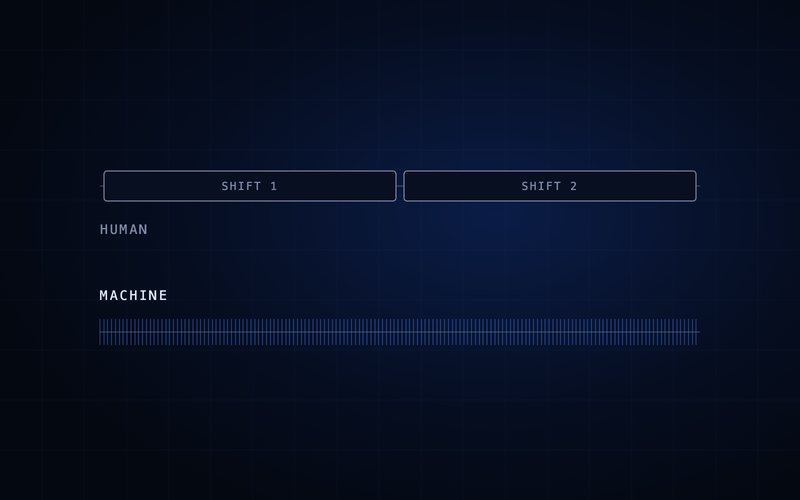
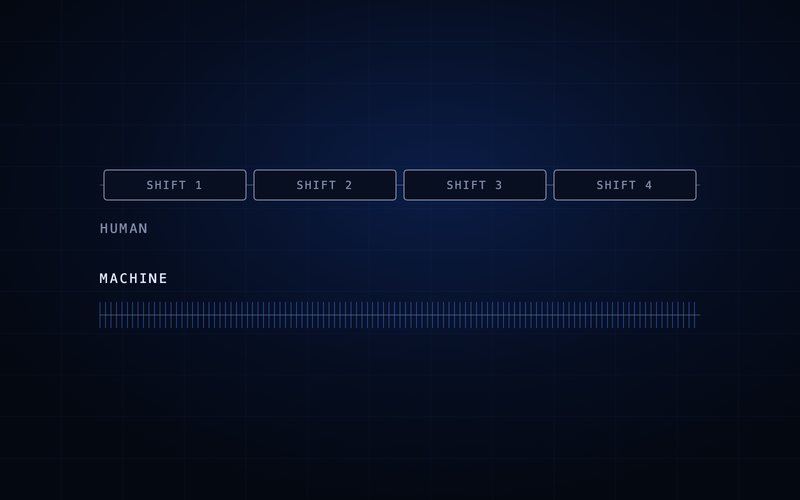
The phrase "automation vs automation" is not a prediction about the future of cybersecurity. It is a description of the present. Attackers are already operating with AI agents that conduct reconnaissance, craft social engineering, deploy adaptive malware, and pivot through compromised environments with minimal human involvement. The question is not whether this is happening. It demonstrably is. The question is whether the defence responds in kind.
The gap in this table is not a gap in analyst skill or team size. It is a gap in architecture. A human-dependent security model operating at biological speed against an AI-powered attack operating at machine speed is not a fair fight. 76% of organisations currently cannot match AI attack speed. The ones that will are the ones that adopt autonomous defence, not as a product upgrade, but as a structural response to a structural problem.
The fundamental question of cybersecurity in 2026 is not which tools you have. It is whether your defence operates at the same speed as the threat. AI has made attacking nearly free and nearly instant. Defence must be both.
Spharaka Networks
05 - The ResponseWhy We Built Spharaka Sphere
The asymmetry described in this post is not a solvable problem with incremental security improvements. Adding a new tool to a fragmented stack, hiring more analysts, or tuning an existing SIEM more carefully does not change the fundamental equation: attackers automate; defenders remain manual.
The only rational architectural response is to match the attacker's automation level. That is what Spharaka Sphere, powered by AuraXP, was built to do.
The Answer to the Asymmetry
Spharaka Sphere - Autonomous Defence for the Automated Threat Era
Not more alerts. Not faster playbooks. A platform that detects, investigates, reasons, and responds autonomously, matching attacker automation with defensive autonomy.
AI Agents. All Domains. Simultaneously.
Specialized AI agents monitor endpoints, networks, cloud workloads, identity, email, and OT environments in parallel. No domain left unwatched, no shift change, no alert backlog.
Detection to Containment. Autonomously.
When a threat is confirmed, Sphere acts: isolating hosts, blocking IPs, revoking tokens, updating firewall rules, in under 60 seconds. No human approval required for high-confidence threats.
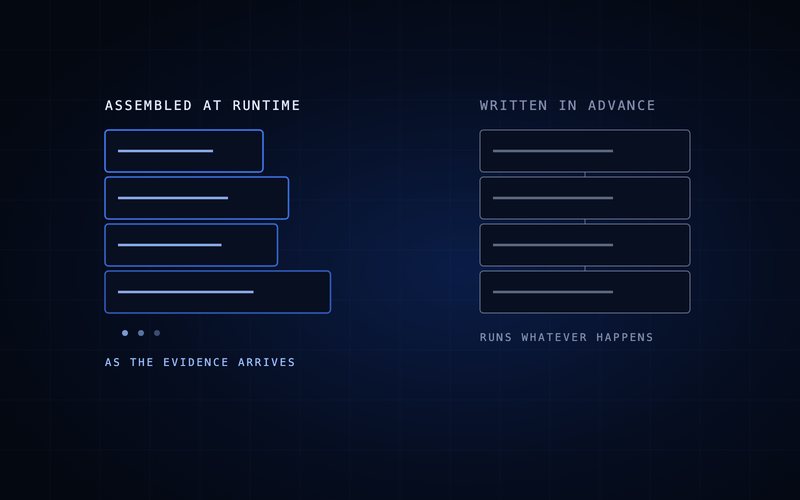
Pre-Written Playbooks Required.
AuraXP's SAGE AI Model generates response plans dynamically from context at the moment of detection, covering novel attacks, new infrastructure, and scenarios no static playbook anticipated.
The defender's economics with autonomous AI: Breach cost research reports that organisations using AI and automation in security operations save an average of $1.9 million per breach. They detect threats 108 days faster. Breach costs fall from $4.44M to $2.54M, a 43% reduction. The same AI revolution that has empowered attackers also empowers defenders, but only if the defence architecture is genuinely autonomous, not just AI-assisted.
The economics of cybercrime have changed permanently. A $20 subscription now powers attacks that cost defenders $120,000 or more. The only equilibrium that restores a defensible position is one where autonomous defence matches automated offense, detecting at machine speed, responding at machine speed, and learning from every incident to close the gap further over time. That is what Spharaka Sphere delivers. And it is exactly what the moment demands.
Frequently asked questions
The Cyber Asymmetry - everything you need to know about AI attack costs, SMB breach economics, and autonomous defence.
How much does it cost to launch an AI-powered cyberattack?
AI-powered cyberattack tools are now available for as little as $20/month. For that amount, an attacker can generate convincing phishing campaigns with 54% higher click-through rates than manual approaches (Programs.com 2025), automate network reconnaissance across hundreds of targets simultaneously, identify SaaS misconfigurations, write and refine exploit code, and scale attacks with no deep technical expertise required. The commoditisation of offensive AI has compressed the entry barrier for cybercrime to near-zero.
How much does a cyberattack cost a small business?
A single successful breach can cost an SMB $120,000 or more in combined impact: incident response costs, legal and regulatory exposure, downtime losses of $15,000 to $50,000 per day, customer churn (55% of customers permanently stop doing business after a breach), and reputational damage. The 2025 annual study of breach costs puts the average cost per incident for small businesses at $254,445. The most alarming statistic: 60% of SMBs attacked by cybercriminals close within six months because the compounding effects of costs, lost customers, and insurance changes make recovery economics impossible.
What is the cyber asymmetry problem?
The cyber asymmetry problem is the growing gap between how cheap it has become to launch a cyberattack and how expensive it remains to be the victim of one. AI has reduced attacker cost to near-zero. A $20 subscription can power a campaign targeting hundreds of organisations. The impact on defenders remains massive: $120,000+ for an SMB, millions for an enterprise. The attacker needs to succeed once; the defender must succeed every time. This asymmetry is structural and worsens as AI tools become cheaper and more capable.
What does 'automation vs automation' mean in cybersecurity?
It describes the new reality: attackers have automated their operations using AI agents that conduct reconnaissance, craft phishing, deploy malware, and adapt to defensive measures without human direction. If defence remains human-dependent, relying on analysts triaging alerts, investigating incidents, approving response actions, it operates at biological speed against machine-speed attacks. 76% of organisations currently cannot match AI attack speed. The only viable response is autonomous defence: AI systems that detect, investigate, and respond at the same speed as automated attacks.
Why can't traditional security tools keep up with AI attacks?
Traditional security tools were built for a world where attacks required human expertise, time, and infrastructure. AI has eliminated all three. A $20 AI tool can do in minutes what previously required weeks of skilled attacker effort. Signature-based detection misses AI-crafted attacks that evolve in real time. Human-staffed SOC teams cannot triage at the volume and speed of AI-automated attack chains. SOAR playbooks break the moment attackers use a slightly different technique. The economics have shifted so dramatically that point-solution defences are structurally inadequate against automated adversaries.
How does Spharaka Sphere address the cyber asymmetry?
Spharaka Sphere powered by AuraXP addresses the cyber asymmetry by matching the automation level of the threat: 40+ specialised AI agents monitor every security domain simultaneously, the SAGE AI Model reasons through threats contextually, and autonomous response executes containment in under 60 seconds without waiting for human approval. When attackers operate at machine speed, defence must too. Sphere's autonomous architecture ensures that the attacker's AI advantage is met with an equal and opposite defensive intelligence.
What percentage of organisations face AI-powered attacks?
87% of organisations worldwide reported experiencing an AI-powered cyberattack in the past year (SoSafe/Programs.com, 2025). 62% of small businesses faced AI-driven attacks in 2025. AI-powered attacks increased 72% year-over-year. 76% of organisations cannot currently match AI attack speed. AI-generated phishing emails achieve a 54% click-through rate, more than four times the rate of manually crafted campaigns, because they are grammatically flawless, contextually personalised, and indistinguishable from legitimate communications.
About the Author
Vishnu Nair is a Founding Member and Director of Growth and Partnerships at Spharaka Networks™. Connect on LinkedIn.
The Asymmetry Ends Here
Discover how Spharaka Sphere matches attacker automation with autonomous defence, detecting, investigating, and responding at machine speed.