The one-line answer
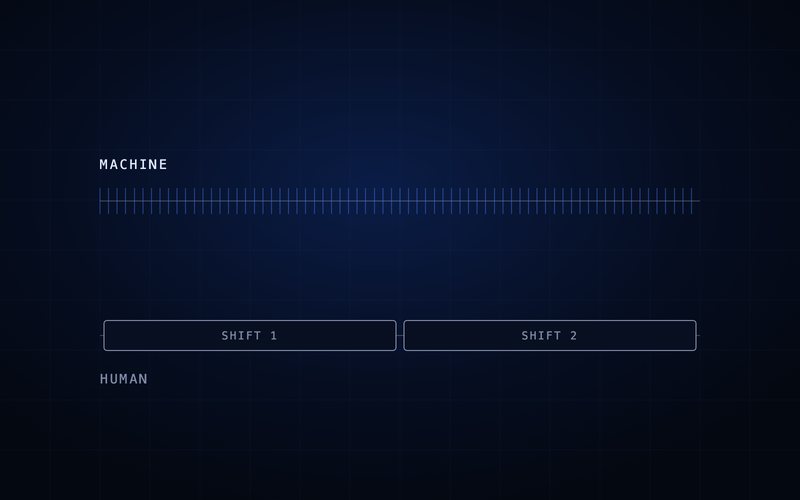
SOAR executes playbooks that a human wrote in advance. Autonomous cyber defence reasons through incidents that no one anticipated. The first scales what you already know. The second acts when you don't yet know what to do.
Both belong in a modern SOC. Confusing them causes buyers to over-invest in scripts they will spend the next three years maintaining, and under-invest in the reasoning layer that decides which script, if any, applies. The distinction is not semantic. It determines what your team spends its time on, how your programme ages, and whether your defence keeps pace with attacker behaviour that changes faster than any content library can be updated.
Why SOAR emerged, and what problem it actually solved
Security Orchestration, Automation, and Response emerged in the mid-2010s to solve a specific, well-understood problem: analysts running the same manual triage steps across a queue of alerts that never shortens. Every SOC had the same repeated motions: pull the IP reputation, check the user's recent logins, isolate the host, open a ticket, notify the owner. A playbook captures those steps as an executable graph. When condition X is met, run enrichment Y, then containment Z.
This was, and remains, a legitimate and valuable capability. It works whenever the incident matches a known shape. Phishing containment, disable-user-on-badge-anomaly, isolate-host-on-known-IOC: SOAR handles these in seconds, with a consistency that a fatigued analyst working alert 400 of the day cannot match. The value proposition was speed and consistency, not judgment. SOAR was never designed to decide what to do. It was designed to do, quickly and repeatably, what a human had already decided in advance.
What SOAR actually is, mechanically
Underneath the orchestration layer, a SOAR platform is a workflow engine. It stores a library of decision trees, each authored by a content engineer, each triggered by a matching condition, each producing a fixed sequence of API calls to the tools in the stack: EDR, identity provider, firewall, ticketing system. The intelligence in the system lives entirely in the humans who wrote the playbooks, not in the system itself.
- Executes pre-authored decision trees, not open-ended reasoning
- Deterministic: identical input produces identical output, every time
- Requires continuous content engineering to stay current with new attack patterns
- Fails silently, or acts incorrectly, on incidents outside its playbook set
- Scales analyst throughput on known-shape work; does not extend analyst judgment
Where SOAR runs out of runway
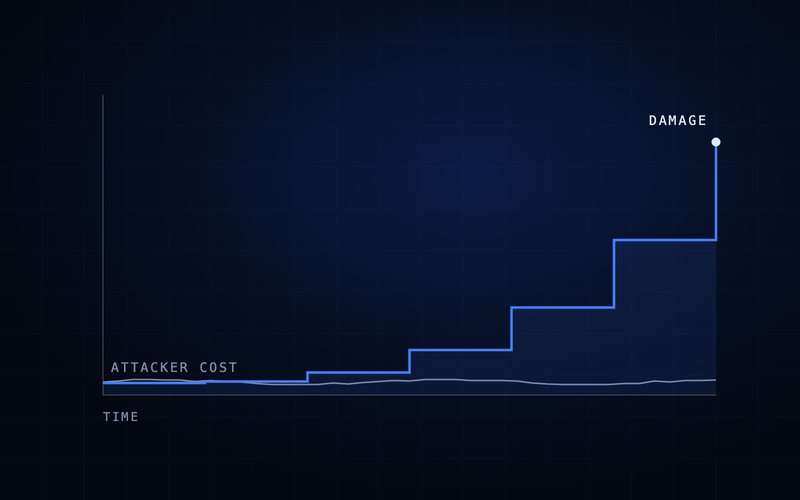
Every mature SOAR programme hits the same wall, usually within eighteen to twenty-four months of deployment. Playbook coverage never catches up to attacker creativity. Content teams write playbooks for last quarter's incident patterns; the adversary is already several patterns ahead, because adversaries adapt in days and content review cycles run in weeks. The net effect is a growing library that increasingly describes threats that no longer occur, alongside a growing backlog of incident types that have no playbook at all.
Playbook drift compounds the problem. Integrations break when vendor APIs change. Enrichment logic goes stale as data sources are retired or renamed. Someone has to own this maintenance, and in most organisations that someone is a detection engineer whose time would otherwise go toward closing actual coverage gaps. What was sold as a productivity gain becomes, several years in, a standing maintenance tax.
The deeper, structural limit is architectural rather than operational: a decision tree cannot reason. If the incoming telemetry doesn't match a known branch, the playbook either does nothing, escalates to a human queue that is already backlogged, or takes an action that was correct for a superficially similar but substantively different situation. There is no mechanism inside a playbook for handling ambiguity, partial evidence, or a genuinely new attack pattern. That is not a bug to be patched. It is the nature of the architecture.
The architectural shift: reasoning and memory versus branching logic
Autonomous cyber defence introduces a reasoning layer that operates above and alongside playbooks. It ingests the same telemetry a SOAR platform would, but instead of matching to a branch, it interprets. It generates hypotheses about what is happening, gathers evidence to test them, correlates signal across identity, endpoint, network, cloud, and OT context, and produces a decision along with a defensible trail explaining how it got there.
The distinction that matters most is memory. A playbook has no state beyond the single execution it is running. An agentic reasoning layer retains context: what happened on this host last week, what this identity's normal behaviour looks like, what has already been ruled out during this investigation. That continuity is what allows it to handle multi-stage, low-and-slow attacks that unfold across days rather than the single-alert incidents playbooks were built for.
In Spharaka's architecture, that reasoning layer is AuraXP, a multi-agent fabric in which specialised agents handle investigation, containment recommendation, and evidence chaining as distinct but coordinated roles. When a known playbook fits the situation, AuraXP invokes it, because there is no reason to reinvent a correct, fast, deterministic response. When no playbook fits, AuraXP still produces a course of action, and its reasoning is recorded so a human can review or override it before high-impact steps run.
Operational implications: the analyst role, MTTI and MTTR, and coverage
The shift from playbook-first to reasoning-first automation changes what analysts actually do day to day. In a SOAR-centric SOC, a meaningful share of analyst time still goes toward the incidents that fall outside playbook coverage, which are, not coincidentally, the ones most likely to matter. In an autonomous defence model, that triage and initial investigation work is handled by the reasoning layer, and the analyst's time shifts toward reviewing proposed actions, tuning policy boundaries, and handling the genuinely ambiguous cases the system escalates by design rather than by failure.
This changes the shape of mean time to investigate and mean time to respond. SOAR reduces MTTR on known-pattern incidents by removing manual execution steps, but it does nothing for MTTI on novel incidents, since investigation there still depends on a human starting from a blank page. Autonomous defence compresses both figures on novel incidents specifically, because the reasoning layer starts the investigation immediately and arrives at a hypothesis before a human analyst would have finished reading the alert.
Coverage follows the same logic. SOAR coverage is bounded by the number of playbooks written, which is itself bounded by content engineering headcount. Reasoning-based coverage is bounded by the quality of the underlying model and the telemetry it can access, which scales differently and does not require a proportional increase in headcount as the threat landscape expands.
Governance and auditability: a different kind of trail
Auditability works differently across the two approaches, and this matters as much to a CISO as raw capability does. A SOAR playbook's audit trail is simple to produce and simple to defend: condition matched, steps executed, timestamps logged. There is little ambiguity because there was little judgment involved.
An autonomous system's audit trail has to capture something harder: not just what action was taken, but why. What evidence was weighed, what alternatives were considered and rejected, what policy authorisation gated the final step. This is a materially harder governance problem, and it is why Spharaka treats it as a first-class layer rather than a logging afterthought. AirWatch, Spharaka's governance layer, records the reasoning chain behind every autonomous decision and enforces the policy envelope that determines which actions can run without additional sign-off. Buyers evaluating autonomous defence should ask specifically how a vendor produces this trail, not just whether an action log exists.
Where SOAR still belongs
None of this argues for eliminating SOAR. Deterministic, high-volume, low-ambiguity operations are exactly where a playbook is the right tool: routine phishing remediation, standard account lockouts, patch-compliance enforcement, ticket routing. These workflows benefit from the predictability that a fixed decision tree provides, and introducing a reasoning layer into them would add cost and latency without adding value. The right question is not whether to keep SOAR, but which fraction of the incident population should still be handled by fixed logic versus reasoning.
A coexistence pattern, and how to evaluate vendors
Autonomous defence does not replace SOAR. It replaces the assumption that SOAR sits at the top of the automation stack. In a properly designed AI SOC, playbooks become the execution layer for the reasoning layer above them: the reasoning layer decides, and SOAR-style automation carries out the specific steps it prescribes. The right mental model is 'agent orchestrates playbook,' not 'agent or playbook.' Buyers who evaluate the two as competitors typically end up with an autonomous engine grafted onto a SOAR they cannot retire, paying the maintenance cost of both without the leverage of either.
The clearest evaluation test for any vendor is straightforward: ask what happens when a genuinely novel incident arrives, one that matches nothing in the playbook library. A SOAR-only product will escalate to a human queue and offer little else. An autonomous cyber defence product will produce a reasoned course of action, cite the specific evidence behind it, and either act within a pre-authorised policy envelope or hand the analyst a decision they can approve in seconds rather than assemble from scratch. That single test tells you, more reliably than any feature list, which layer of the stack you are actually buying.
- Ask what the system does with an incident that has no matching playbook
- Ask how reasoning, not just actions, is recorded and made auditable
- Ask what policy authorisation governs autonomous, high-impact actions
- Ask how existing SOAR content is preserved or absorbed, not discarded
- Ask how coverage scales as attack patterns change, without linear headcount growth
Frequently asked questions
Is autonomous cyber defence just marketing for AI SOAR?
No. AI SOAR typically means AI-assisted authoring of playbooks: a model helps a content engineer draft or refine decision trees, but a human still writes and approves the branch logic in advance. Autonomous cyber defence uses AI to make and justify decisions in real time when no playbook applies. Both use AI; they solve different problems and sit at different layers of the stack.
Do we need to rip out our existing SOAR?
Usually not, and doing so would be wasteful. Autonomous cyber defence platforms are typically deployed above SOAR, with the reasoning layer calling existing playbooks as its execution mechanism for known-shape incidents. Retire only the content that has become pure maintenance overhead with no remaining coverage value.
How does Spharaka Sphere deliver autonomous cyber defence?
Sphere pairs the AuraXP agentic fabric with the SAGE AI model. AuraXP handles multi-agent reasoning, evidence correlation, and orchestration across specialised agents; SAGE provides the cybersecurity-native inference those agents reason with. Together they act on incidents that fall outside pre-authored playbooks, while still invoking existing playbooks where they remain the correct, deterministic response.
Is autonomous action safe to run without a human in the loop?
Autonomous action operates under a defined policy envelope, not unconstrained discretion. High-impact actions require pre-defined authorisation thresholds, and the AirWatch governance layer records the reasoning behind every decision and enforces the guardrails that determine what can run automatically versus what requires sign-off. The design goal is autonomy without loss of control, not autonomy for its own sake.
How do we measure whether the switch from SOAR-only to autonomous defence is working?
Track mean time to investigate and mean time to respond specifically on incidents that previously had no playbook coverage, not just aggregate figures across all incidents. Also track the share of analyst time spent on genuinely novel investigation work versus reviewing system-proposed actions, and the rate of playbook content that goes unmaintained. Improvement on the novel-incident metrics is the clearest signal that the reasoning layer, not just automation volume, is delivering value.
Pillar: What is Autonomous Cyber Defence?
The full definitional guide.
Autonomous Cyber Defence Platform
The category page: what the platform is and what sits under it.
AI SOAR capability
How Spharaka's SOAR layer executes agent-directed playbooks.
AI SOC platform
Where autonomous defence lives inside the SOC.
AuraXP™ agentic fabric
The reasoning layer that decides which playbook applies.
Dynamic playbook creation
How playbooks are generated on the fly.