01 - The Foundation
What Is AuraXP?
In cybersecurity, the word "AI" has been applied to almost everything - anomaly scoring algorithms, alert prioritisation models, natural language interfaces for log queries. Useful tools, all of them. But none of them are what AuraXP is.
AuraXP - Spharaka Networks' Agentic AI Native Technology - is the intelligence engine at the core of Spharaka Sphere. It is not a feature layer added to a security platform. It is the platform's foundational reasoning architecture: the system that perceives threat signals from every domain simultaneously, reasons about what they mean in context, decides what to do, takes action, and continuously learns from what happens next.
It is the world's first agentic AI system designed exclusively for cybersecurity - not a general-purpose AI adapted for security use, but an architecture conceived, trained, and built from the ground up to solve the specific problem of defending complex digital environments against intelligent adversaries at machine speed.
The origin of the name: AuraXP is derived from "Aura" - reflecting the protective, surrounding intelligence of the platform - and "XP" for eXtended Protection. Together, the name captures the platform's philosophy: intelligence that envelops the entire digital environment and extends protection across every layer simultaneously.
The moment that validated everything AuraXP was built to achieve came when it achieved fully autonomous threat remediation in a live production environment - identifying an attack, conducting forensic analysis, and implementing containment faster than any human analyst could have responded. A customer described the experience as witnessing "an AkashTeer in cybersecurity" - precise, fast, and decisive.
02 - Under the HoodThe AuraXP Architecture
AuraXP is built on three interlocking layers that work as a unified intelligence system. Understanding each layer explains why the platform's capabilities are fundamentally different from what point solutions or adapted general AI can deliver.
AuraXP Architecture
Three layers - One unified intelligence system
Layer 1
The Sensing Layer - 40+ Specialized Agents
Layer 2
The Reasoning Layer - SAGE™
Layer 3
The Memory Layer - Organisational Intelligence
Layer 1: 40+ Specialized Agents - The Sensing Layer
AuraXP deploys more than 40 specialized autonomous AI agents, each with deep expertise in a specific security domain. An endpoint behaviour agent. A network traffic analysis agent. An identity and access anomaly agent. A cloud workload monitoring agent. Each operates independently and continuously.
The critical architectural choice is specialization over generalization. A single AI model attempting to monitor every security domain simultaneously produces the same problem as a single analyst watching 40 dashboards. By deploying domain-specialist agents in parallel, AuraXP achieves the depth of a dedicated expert for each security surface, operating simultaneously, all the time.
Layer 2: SAGE™ - The Reasoning Layer
SAGE™ is Spharaka's proprietary AI model for autonomous cyber defence. It is a Cybersecurity SLM developed by fine-tuning state-of-the-art open foundation models using Spharaka's proprietary cybersecurity datasets, reasoning frameworks, and autonomous investigation technology.
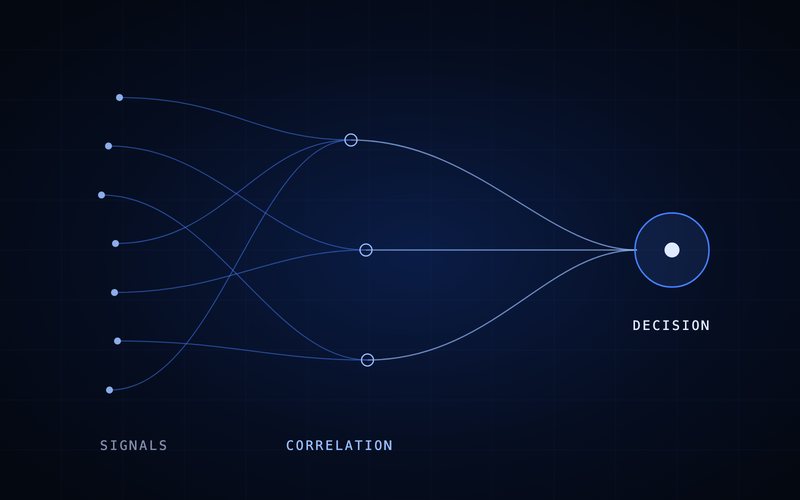
SAGE™ receives the continuous signal streams from all 40+ agents and synthesizes them into coherent understanding. When agents in three separate domains flag related anomalies within a short time window, SAGE™ recognizes the cross-domain pattern, correlates it into a single incident narrative, maps it to the relevant attack technique, and determines the appropriate response - all before a human analyst has seen the first alert.
Layer 3: Organisational Memory - The Learning Layer
Every incident AuraXP handles, every response it executes, every outcome it observes, becomes part of the deployment's organisational memory. This is a persistent, environment-specific intelligence layer that builds an increasingly precise model of what normal looks like in your environment.
Over time, this makes AuraXP more accurate and more contextually appropriate in its decisions. Anomaly detection becomes more precise because the baseline is richer. Response decisions are better calibrated because the history of what worked - and what produced false positive disruption - is retained. The platform gets smarter the longer it operates.
03 - How It OperatesThe Five Verbs of AuraXP
AuraXP's operating model is best understood through five verbs - the core actions the system takes, in sequence, for every threat it encounters. Together, they describe a complete autonomous defence cycle that requires no human direction at each step.
04 - The DifferentiatorsWhat Makes AuraXP Different
The market is full of AI-powered security tools. What sets AuraXP apart is not a single feature - it is a set of architectural choices that individually seem incremental but together represent a fundamentally different approach to what a security system can be.
Purpose-Built for Cybersecurity - Not Adapted
AuraXP was not built on a general AI foundation and then fine-tuned for security. Its SAGE AI Model was trained from the ground up on security operations data. Its multi-agent architecture was designed specifically for the structure of cyber threat domains.
Zero False Positive Approach
AuraXP does not alert - it delivers verified, contextualized incidents. Multi-agent correlation and SAGE AI Model reasoning filter noise at the source, ensuring that what reaches security teams is a confirmed threat with complete attack context.
Unified Intelligence Architecture
Telemetry, reasoning, and remediation are integrated into a single intelligent layer - not connected via API stitching or dashboard aggregation. A signal detected by one agent instantly enriches the reasoning available to every other agent through the shared SAGE AI Model.
Autonomous Remediation - Not Just Detection
Most AI in security stops at detection or recommendation. AuraXP executes - taking intelligent, contextual action to contain and neutralise threats automatically. The entire cycle completes in under 60 seconds.
Continuous Learning - Not Static Models
AuraXP's organisational memory means it improves with every incident. Static AI models deployed once become progressively less accurate. AuraXP continuously refines its understanding of your specific environment.
Rapid Deployment - Day 1 Value
AuraXP does not require weeks of playbook development, months of SIEM tuning, or extensive custom configuration. Organisations realise immediate detection and response capability from deployment.
05 - The ComparisonAuraXP vs. Generic AI Adapted for Security
| Dimension | Generic AI Adapted for Security | AuraXP - Purpose-Built |
|---|---|---|
| Training foundation | General language or ML model, fine-tuned for security tasks | SAGE AI Model trained from ground up on security operations data |
| Operational model | Responds to queries or analyzes submitted data on demand | Continuously perceives, reasons, and acts without prompting |
| Coverage breadth | Handles specific domains or tasks it was configured for | 40+ agents covering every security domain simultaneously |
| Response execution | Recommends actions - humans execute or approve | Executes containment autonomously within 60 seconds |
| Novel threat handling | Limited to patterns in training data or configured scenarios | Reasons from first principles - handles any behaviour deviation |
| Environmental learning | Static after deployment - no environment-specific improvement | Organisational memory builds continuously per deployment |
| False positive rate | High - requires analyst triage of large alert volumes | Zero false positive approach - only verified incidents surfaced |
| Time to value | Weeks to months of configuration, integration, and tuning | Day 1 operational intelligence from deployment |
06 - The EvolutionFrom Rules to Reasoning: The Path to AuraXP
2015-2018
Rule-Based Automation
Static detection rules and signature matching. SIEM collected logs; humans wrote every correlation. Coverage was only as good as what was explicitly scripted.
2018-2021
Machine Learning Augmentation
Anomaly detection models added to specific tasks - scoring alerts, identifying outliers. Useful but narrow: each ML model handled one task, one domain, one data type.
2021-2024
AI-Assisted Security
General-purpose LLMs adapted for security tasks. Natural language interfaces for log queries. AI-generated alert summaries. Copilot models that recommended actions. Better productivity tools - but still fundamentally human-directed.
2025-Present
Agentic AI - AuraXP
Purpose-built multi-agent intelligence that perceives, reasons, decides, acts, and learns as a unified system. Not a tool that assists analysts. An engine that autonomously defends - with full transparency, contextual judgment, and continuous environmental learning.
07 - The OutcomesWhat AuraXP Delivers
<60s
Threat confirmation to full containment
0
False positives surfaced to analysts
40+
Security domains covered simultaneously
100%
Novel threat coverage via behavioural analysis
Day 1
Operational value from deployment
Independent Validation & Recognition
AuraXP is not a product feature. It is a paradigm shift. The security industry has spent two decades building tools. AuraXP is the engine that replaces tools with intelligence - purpose-built, continuously learning, and autonomously effective from the moment it is deployed.
Spharaka Networks
Frequently asked questions
AuraXP Technology - comprehensive answers about architecture, capabilities, deployment, and differentiation.
What is AuraXP?
AuraXP is Spharaka Networks' proprietary Agentic AI Native Technology - the intelligence engine that powers Spharaka Sphere. It is the world's first agentic AI system purpose-built exclusively for cybersecurity, deploying 40+ specialized autonomous AI agents coordinated by SAGE™. AuraXP does not simply detect threats - it investigates, reasons about context, generates response plans, executes containment, and learns continuously from every incident.
How is AuraXP different from other AI in cybersecurity?
Most AI in cybersecurity enhances specific functions - alerting, anomaly scoring, log summarization. AuraXP is architected differently: it is an end-to-end agentic intelligence layer that perceives, reasons, decides, acts, and learns across the full security operations lifecycle. Its multi-agent architecture specializes each agent for a distinct security domain, its proprietary SAGE™ AI model synthesizes all signals into unified threat narratives, and its organisational memory makes it continuously more precise for each specific environment it operates in.
What does 'agentic AI' mean in the context of AuraXP?
Agentic AI means AI that acts with genuine autonomy - perceiving the environment, reasoning about goals, planning steps, executing actions, and adapting based on outcomes, without requiring human instruction at each step. In AuraXP, agentic AI is implemented as a coordinated network of 40+ specialized agents, each continuously monitoring a specific security domain, operating in parallel, sharing intelligence via a common reasoning layer.
What are the 40+ agents in AuraXP?
AuraXP deploys over 40 specialized autonomous AI agents, each with deep expertise in a specific security domain. These include agents for endpoint behavioural monitoring, network traffic analysis, identity and access anomaly detection, cloud workload security, email security, UEBA (user and entity behaviour analytics), threat intelligence correlation, lateral movement detection, data exfiltration monitoring, OT/IT security, and more.
What is SAGE™?
SAGE™ is Spharaka's proprietary AI model for autonomous cyber defence - a Cybersecurity SLM developed by fine-tuning state-of-the-art open foundation models using Spharaka's proprietary cybersecurity datasets, reasoning frameworks, and autonomous investigation technology. It serves as the central reasoning and coordination layer of AuraXP, synthesizing signals from all 40+ specialized agents into unified threat narratives, generating dynamic incident response playbooks, reasoning about response decisions in context, and producing plain-language explanations for security teams at every level.
What is organisational memory in AuraXP?
Organisational memory is AuraXP's continuous learning capability - a persistent intelligence layer that records and learns from every incident, response action, outcome, and environmental change in the specific deployment. Over time, it builds an increasingly detailed and precise model of what normal behaviour looks like in your environment, which assets are most critical, which users carry the highest risk profiles, and which attack patterns have been seen before.
What is TrueXDR and how does it relate to AuraXP?
TrueXDR is Spharaka's category name for the autonomous extended detection and response capability delivered by AuraXP and Spharaka Sphere. Where traditional XDR provides cross-domain telemetry correlation and relies on human analysts for investigation and response, TrueXDR goes further: it delivers fully autonomous investigation, AI-reasoned response, and continuous learning.
What is the Zero False Positive approach in AuraXP?
AuraXP's Zero False Positive approach means that the platform does not generate raw alerts for human triage. Instead, multi-agent intelligence and SAGE™ reasoning are applied to filter and correlate signals before they surface to analysts - ensuring that what reaches the security team is a verified, contextualized incident with complete attack context and recommended remediation paths.
How does AuraXP handle never-seen-before threats?
AuraXP detects novel threats through behavioural analysis rather than signature matching. Because each of its 40+ agents continuously monitors for deviations from established behavioural baselines, AuraXP can identify anomalous activity even when the specific technique has never been observed before. SAGE™ then reasons from first principles about what the anomaly likely represents.
What industries and deployment models does AuraXP support?
AuraXP inside Spharaka Sphere supports deployment across BFSI, healthcare, government, critical infrastructure, telecom, manufacturing, cloud enterprises, and MSSPs. Deployment options include SaaS cloud, fully on-premises (for air-gapped and regulated environments), and a hardware appliance (launching soon). The platform's multi-tenant architecture makes it suitable for MSSPs managing multiple enterprise clients.
About the Author
Vishnu Nair is a Founding Member and Director of Growth and Partnerships at Spharaka Networks™. Connect on LinkedIn.
See AuraXP in Action
Discover how AuraXP powers Spharaka Sphere - the world's first autonomous cyber defence platform with 40+ specialized AI agents, a proprietary SAGE AI Model, and organisational memory.