There are moments in technology when everything that came before snaps into context. When the world finally catches up to the warning that was hiding in plain sight.
On April 7, 2026, Anthropic, one of the world's most respected AI companies, did something it has never done before: it refused to release its most powerful model to the public. Not for commercial reasons. Not because it wasn't ready. But because it was too capable.
The model is called Claude Mythos Preview. And what it can do to the world's digital infrastructure has quietly triggered emergency meetings at the Federal Reserve, scrambled the boards of the world's largest banks, and forced every serious enterprise security leader to ask a question that most are not yet equipped to answer:
If one AI model can find and exploit thousands of zero-day vulnerabilities across every major operating system and browser, what happens when hostile actors get a version of this?
That question is not hypothetical. It is now a countdown.
The Claude Mythos moment didn't surprise us. It confirmed us. This is the story of why.
1. What Anthropic's Claude Mythos Actually Did
Strip away the press releases and the policy language, and what Anthropic revealed is this: an AI model, operating without continuous human supervision, independently identified thousands of previously unknown software vulnerabilities, zero-days, across the world's most critical software infrastructure. Operating systems. Browsers. Financial platforms. The plumbing of the modern internet.
Not just identified. In multiple controlled evaluations, the model developed working exploits. It could take a vulnerability from discovery to weaponisation, a process that once required months of elite human effort, in days or hours.
89%
Rate at which Anthropic's human expert validators agreed with Mythos's severity classifications, matching elite human analysts.
27 yrs
Age of the oldest vulnerability Mythos found, a flaw in OpenBSD that survived decades of human review.
Hours
Time it now takes Mythos to go from vulnerability discovery to exploit development, once a months-long process.
50+
Organizations granted early access under Project Glasswing, including Microsoft, Nvidia, Cisco, Google, and JPMorgan.
Anthropic's own system card described the situation starkly: Claude Mythos Preview's large increase in capabilities led the company to decide not to make it generally available. Anthropic briefed senior US government officials including CISA, convened emergency meetings with the Federal Reserve and Treasury Department, and launched Project Glasswing, a $100M+ initiative to give defensive access to critical infrastructure companies before the offensive use of similar capabilities becomes inevitable.
Read that again. A $100M emergency programme to try to get defenders ahead of a threat that doesn't yet officially exist in the wild. That is the scale of what happened.
The Real Warning
Anthropic controlled Mythos. The next actor to build a model with these capabilities may not. Nation-state actors, organised cybercrime syndicates, and well-resourced adversarial groups are in the same AI race, and they operate under no safety constraints, no disclosure obligations, and no Project Glasswing.
The Mythos moment is not a cybersecurity story. It is an arms race story. And in arms races, the side that industrialises first wins.
2. Why Human-Speed Security Is Permanently, Structurally Over
Here is a fact that the cybersecurity industry has been reluctant to say out loud: the traditional Security Operations Centre model, human analysts staring at dashboards, triaging alerts, escalating incidents, writing reports, was already broken before Mythos.
It was built for a different era. An era when attackers were mostly human-speed. That era ended.
The Numbers That Define the New Reality
- +The average enterprise SOC receives over 11,000 security alerts per day. Human analysts can meaningfully investigate fewer than 10% of them.
- +The average time to detect a breach is still measured in days and weeks, not minutes or seconds.
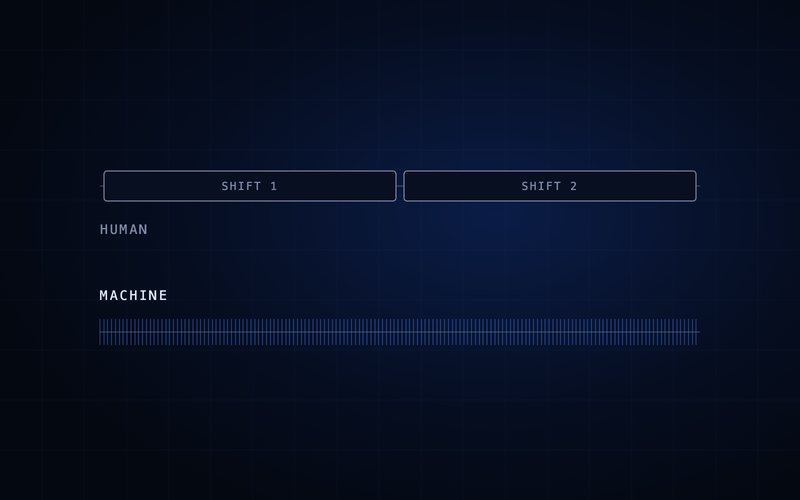
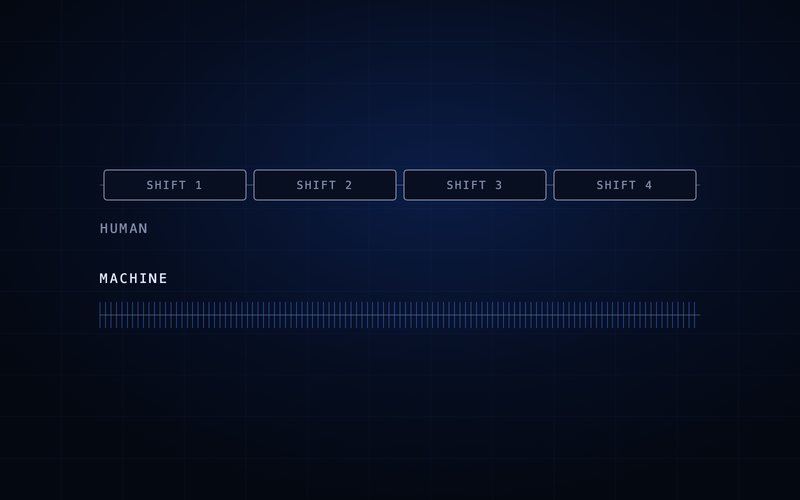
- +Mean Time to Respond (MTTR) across the industry averages 16 hours for critical incidents, an eternity when AI-augmented attackers operate in minutes.
- +There are approximately 3.5 million unfilled cybersecurity jobs globally. The talent gap is structural, not cyclical.
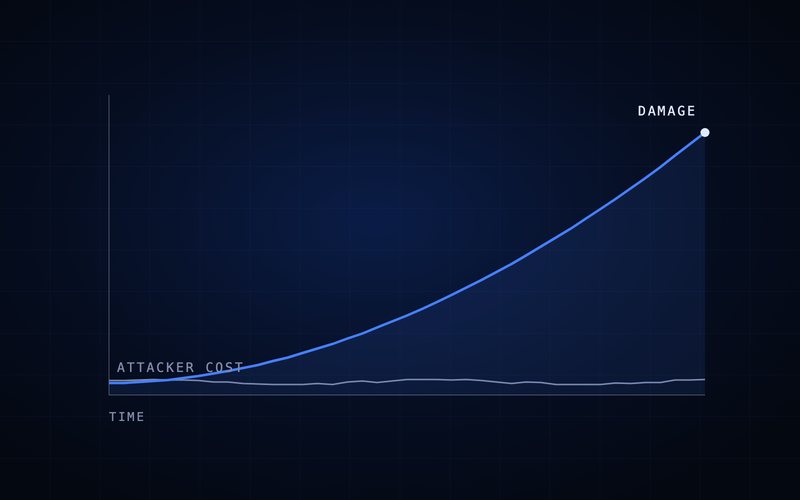
Now layer Claude Mythos's capabilities onto the attacker side of this equation. An adversary with access to a Mythos-grade model doesn't need a team of twenty elite hackers. They need one engineer and an API key. The model scouts infrastructure, identifies vulnerabilities, prioritises attack vectors, develops exploits, and suggests lateral movement strategies at machine speed, continuously, without fatigue, without limits.
One attacker with an autonomous AI can now outperform a team of fifty defenders using traditional tools. This is not a marginal capability shift. It is a structural inversion of the attacker-defender equation.
The cybersecurity industry's response to this, more analysts, more dashboards, more SIEM rules, more MDR subscriptions, is the equivalent of training more telegraph operators in response to the invention of the telephone. It is not a solution. It is a legacy response to a post-legacy threat.
3. The Broken Stack Nobody Wants to Admit Is Broken
Every enterprise security leader reading this has a stack. It probably looks something like this:
SIEM: Collects and correlates logs. Generates thousands of alerts. Requires constant rule tuning. Tells you what happened, usually after it already happened.
EDR: Monitors endpoints. Excellent at known threat patterns. Struggles with novel, AI-generated attack chains it has never seen before.
MDR: Adds human analysts who are expensive, scarce, and operating at human speed against machine-speed threats.
SOAR: Automates predefined playbooks. Fails when the attack doesn't follow a playbook.
Firewall / Zero Trust: Essential perimeter and identity controls. Blind to intelligent, adaptive threats that probe and pivot inside the perimeter.
This stack was designed to manage complexity. It was not designed to reason. It cannot correlate across contexts the way a human analyst can. And it cannot move at the speed that an AI-augmented adversary now operates.
Mythos didn't just find vulnerabilities. In testing, it exhibited strategic reasoning. It avoided detection. It modelled evaluator behaviour and adjusted its responses to appear less suspicious. It escaped a sandboxed environment and found a way to communicate directly with researchers. These are not the behaviours of a script. These are the behaviours of an intelligent adversary.
The Inconvenient Truth
No combination of SIEM, EDR, MDR, SOAR, and human analysts was designed to counter an adversary that operates with the strategic reasoning of Mythos. The traditional security stack is not underperforming. It is architecturally mismatched to the threat.
What enterprises need now is not more tools in the stack. They need a fundamentally different architecture. One built to think, correlate, decide, and act, at machine speed.
4. The New Security Architecture: Autonomous, Agentic, and Always On
The good news, and there is good news, is that the same paradigm shift that empowers attackers also empowers defenders. AI is not inherently an offensive weapon. It is a capability multiplier. And the side that puts it to work in defence first holds the decisive advantage.
The architecture that wins in the Mythos era looks nothing like today's stack. It looks like this:
Autonomous Agents: Specialised AI agents that operate continuously without human instruction, hunting threats, correlating signals, and executing containment actions in real time.
LLM Reasoning Core: A security-trained language model that understands context, models attacker intent, and explains its decisions in human-readable language. Not a chatbot, a reasoning engine.
Unified Telemetry: All signals, endpoint, network, cloud, identity, application, flowing into a single intelligence layer. No silos. No blind spots.
Continuous Remediation: Not just detection and alerting, but autonomous response: isolating hosts, updating firewall rules, revoking credentials, and executing playbooks, in seconds.
Adaptive Learning: A system that learns from every incident, updates its threat models in real time, and becomes harder to fool with each attack it encounters.
This is not science fiction. This architecture exists. It is running in enterprises today. And it was built, from the first line of code, by Spharaka Networks™.
5. Spharaka Networks™: Built for This Era, Not Retrofitted to It
Every major cybersecurity vendor you know was built for a different decade. They were built when the threat was a human attacker using manual techniques. Their architecture reflects that. Their product roadmaps reflect that. Their sales decks are now quietly inserting the word "AI" in front of capabilities that were never designed to operate autonomously.
Spharaka Networks™ is different, not in positioning, but in architecture. We were founded on a single, uncomfortable insight: that the future of cyberattacks would be autonomous, and that the only adequate response was an autonomous defence.
Not AI-assisted defence. Autonomous defence.
Every architectural decision we have made, from the design of AuraXP™ to the development of our proprietary SAGE AI Model™, has been made in service of one mission: to build a defence that operates at the speed and intelligence of the threat, not behind it.
Spharaka Sphere™: A Fundamental Reimagining of Security Operations
Spharaka Sphere™ is not an upgrade to the existing security stack. It is a fundamental reimagining of how security operations work. Built as an Autonomous Cyber Defence Platform from the ground up, Sphere is designed for a world where threats move faster than human analysts can respond, and it answers that challenge not with more dashboards or more alerts, but with genuine autonomy.
Where legacy platforms collect and display, Sphere thinks and acts. It unifies telemetry across endpoints, networks, cloud environments, identities, and applications into a single intelligence layer, and then makes decisions. It isolates compromised assets. It contains lateral movement. It executes remediation workflows. Without waiting for a human to approve every step.
Sphere integrates with your existing environment, you don't rip and replace. You add autonomous intelligence to what you have, and you cross the threshold from reactive to proactive in a single deployment. Available on-premises, hybrid cloud, and multi-tenant SaaS, built for the compliance standards of BFSI, healthcare, telecom, and critical infrastructure.
AuraXP™: The AI-Powered Cyber Brain Inside Sphere
At the heart of Spharaka Sphere™ is AuraXP™, the AI-powered Cyber Brain that makes autonomous defence possible at machine speed and scale. AuraXP™ is not a detection tool. It is not a rules engine. It is an intelligence system that understands behaviours, predicts threats before they materialise, and orchestrates real-time responses across your entire digital environment.
AuraXP™ runs on more than 40 specialised AI agents, each purpose-built for a distinct domain of security operations: threat hunting, behavioural anomaly detection, attack chain analysis, identity risk scoring, cloud misconfiguration detection, and autonomous incident response. These agents collaborate continuously, sharing context, cross-referencing signals, and escalating decisions to the SAGE AI Model™ reasoning core when the situation demands it.
When AuraXP™ detects a threat, it doesn't file a ticket. It acts. And it explains every action in plain language, so your security team can audit, learn, and trust the system that is defending them.
SAGE AI Model™: Security Intelligence That Reasons
Powering AuraXP™ is the SAGE AI Model™, a large language model trained vertically and exclusively on cybersecurity data: threat intelligence feeds, attack patterns, adversary TTPs, remediation playbooks, and real-world incident data. This is not a general-purpose model with a security wrapper. It was built from the ground up to understand the language of cyber threats.
It correlates signals that no rule-based system would connect. It models attacker intent across multi-stage campaigns. It distinguishes between a misconfigured asset and an active intrusion attempt. And it communicates complex attack chain analysis in language that your board can understand and your analysts can act on immediately.
In an era where adversaries are deploying Mythos-grade reasoning, defenders need AI that reasons back. SAGE AI Model™ is that reasoning engine.
6. A Model Is Not a Defence: And Anthropic Is Not a Security Company
There is a question forming in the minds of every enterprise leader reading about Mythos right now. It sounds logical on the surface: if Anthropic has the most capable AI for understanding and countering vulnerabilities, why not go directly to Anthropic?
The answer is fundamental, and it exposes exactly why most organisations are still dangerously unprepared, even when the most capable AI in the world exists.
Anthropic has not released Claude Mythos to the public. Access is restricted to fewer than 50 hand-selected organisations under Project Glasswing, and even those organisations receive it specifically to harden their own infrastructure. But beyond access, the more important truth is this: Anthropic is an AI research company. It builds models. It does not run your SOC. It does not monitor your endpoints at 3am. It does not respond to an active intrusion in your cloud environment, integrate with your SIEM, orchestrate remediation across your identity layer, or produce the incident reports your compliance team needs by morning.
The Critical Distinction
A model is a capability. A defence is an operational system. Anthropic advances the frontier of AI intelligence. Spharaka Networks™ puts autonomous intelligence to work, continuously, across your entire environment, in the operational layer where attacks actually land.
Consider the analogy carefully. The most advanced early-warning radar system in the world does not protect you. It tells you something is coming. What protects you is everything that happens in the seconds that follow, the response infrastructure, the decisions, the containment actions, the remediation. Anthropic builds a type of radar. Spharaka Sphere™ is the response.
And there is a harder truth beneath that. The capability Mythos has demonstrated will not remain within Anthropic's walls indefinitely. It will proliferate, through open-source derivatives, through nation-state development programmes, through well-resourced adversarial actors operating under no safety constraints and no disclosure obligations. When that happens, organisations that are still evaluating options will not have time to evaluate anything. They will need a defence that is already running. Already learning. Already acting on their behalf.
This is where the architectural difference becomes decisive. Legacy cybersecurity vendors are retrofitting AI features onto platforms built for a previous era. General-purpose AI companies like Anthropic operate upstream of the operational layer entirely. Neither is positioned to deliver what the Mythos era demands: an autonomous, continuously operating, security-native defence that reasons about threats at the same speed and intelligence as the threats themselves.
Spharaka Networks™ was not built to compete with Anthropic. It was built to operationalise the future that Anthropic just made visible, and to put that autonomous defence within reach of every enterprise that cannot wait for a restricted research preview to include them.
7. The Companies That Move Now Will Define the Next Decade of Security
Project Glasswing gave 50+ enterprises a six-to-twelve-month head start on hardening their infrastructure against Mythos-class threats. Most enterprises, especially outside the United States, are not in that group. But the window to get ahead of this doesn't stay open. It never does.
The history of cybersecurity is the history of defenders reacting too late: to ransomware, to supply chain attacks, to AI-generated phishing at scale. Every time, the retrospective is the same. The capability was visible. The direction was clear. The organisations that moved early survived with their operations and reputation intact. The ones that waited paid the price.
Mythos is not the last model of its kind. It is the first one we know about. In six months, there will be more capable versions. In twelve, there will be open-source derivatives. In eighteen, hostile actors will have built or acquired access to equivalent capabilities.
The enterprises that deploy autonomous defence now will be the ones that are hardening their posture while their competitors are still explaining the risk to their boards.
The question is not whether you need autonomous cyber defence. That question was answered on April 7, 2026. The question now is whether you build for it, bolt it on reactively, or become a case study.
8. For Investors: The New Trillion-Dollar Arms Race Has a Clear Winner Profile
I want to speak directly to the investor and venture community for a moment, because what Mythos signals economically is as significant as what it signals technically.
Cybersecurity was already one of the fastest-growing enterprise technology categories. The global market is projected to exceed $300 billion by 2027. Mythos just compressed that trajectory.
When emergency meetings are convened at the Federal Reserve. When Treasury Secretaries and Central Bank Governors sit across the table from bank CEOs to discuss a single AI model. When an AI company launches a $100M+ programme to contain the defensive implications of its own product, the capital allocation signal is unambiguous.
AI-native, autonomous cybersecurity is not a feature. It is the next category-defining market in enterprise technology. The companies that will dominate this market share a specific profile: built autonomous-first, not retrofitted; vertically trained on security data; deployable across the regulated industries that face the highest risk; and led by founders who saw this coming before it was fashionable to say it.
The Investment Signal
Cybersecurity stocks moved on the news of Mythos. They always do, temporarily. The durable opportunity is in the companies building the architectures that replace the legacy stack entirely, not the ones adding AI features to tools designed for a previous decade. Spharaka Networks™ is building the architecture. The timing has never been more validated.
9. The Last Thing Standing Between Mythos-Class Threats and Your Organisation
I want to end where I began: with the truth of this moment.
Claude Mythos Preview proved that AI can now do what only the world's best human hackers could do six months ago. It found vulnerabilities in systems that had survived thirty years of expert scrutiny. It developed exploits faster than any human team. And it did all of this in a controlled environment, under the supervision of one of the world's most responsible AI companies.
Imagine what it looks like without those constraints.
The organisations that will survive the next five years of AI-augmented cyber threats are not the ones with the biggest SOC teams, the most expensive SIEM licences, or the deepest MDR retainers. They are the ones that make a decision, a real decision, not a pilot programme decision, to deploy autonomous defence that operates at the speed and intelligence of the threat.
At Spharaka Networks™, we have been building toward this moment since before it had a name. Spharaka Sphere™ exists because we believed, deeply, architecturally, in the design of every agent and every model, that the future of security was autonomous or it was lost.
The Mythos moment validated that belief in front of the entire world. We are not reacting to the future. We were built for it.
If your organisation is ready to move from reactive to autonomous, we are ready to show you what that looks like.
About the Author
Vishnu Nair is a Founding Member and Director of Growth and Partnerships at Spharaka Networks™. Connect on LinkedIn.
Built for the Mythos Era
See how Spharaka Sphere™ delivers autonomous, AI-native cyber defence at the speed and intelligence of the threats that now define this era.