The Quiet Expiration
Somewhere between two board meetings last quarter, the economics of cyber offense changed forever, and most enterprises didn't notice.
The firewall is still humming. The SIEM dashboards still glow green. The quarterly pen test still came back "acceptable with remediation." And yet, the entire intellectual foundation those systems were built on has quietly expired.
For thirty years, cybersecurity has been an exercise in friction engineering. The unspoken doctrine was simple: make exploitation expensive enough in time, skill, patience, or attention, and most adversaries will move on to softer targets. We didn't build walls. We built inconvenience. CAPTCHAs, rate limits, multi-step logins, obscure ports, alert queues, manual review gates. Each one a small tax on attacker patience.
That doctrine just became obsolete.
When the attacker is no longer a person but an autonomous system that can attempt the same exploit chain ten thousand times overnight at near-zero marginal cost, while your SOC analysts are in a status meeting, friction is not security. Friction is theater.
The last twelve months have not produced a new generation of attackers. They have produced a new species.
What Changed in the Last 12 Months
This was the year the offensive AI stack stopped being theoretical.
Autonomous AI agents capable of planning, executing, and adapting multi-step intrusion campaigns without human intervention moved out of research labs and into the operational workflows of both criminal syndicates and state-aligned actors. What used to require a team of skilled operators now runs as a loop on commodity GPUs.
Phishing, the oldest vector in the playbook, was rebuilt on top of large language models. Attackers no longer send broken-English mass blasts. They send context-aware, individually personalized messages crafted from scraped LinkedIn profiles, leaked Slack archives, and breached email histories. Voice cloning made vishing convincingly real. Deepfake video brought executive impersonation into Zoom calls. The "spot the typo" defense is dead.
Reconnaissance was automated end-to-end. AI agents now crawl exposed infrastructure, fingerprint software versions, correlate them against public CVE databases, and chain exploits across attack surfaces with patience no human ever possessed. Vulnerability discovery, once a craft, became a cron job.
The skill barrier collapsed. A teenager with $200 of API credits can now orchestrate attacks that previously demanded a tier-one threat actor. The talent moat that protected most enterprises, the comforting assumption that "we're not interesting enough for nation-state attention," has dissolved into nothing.
The defenders? Outnumbered, outpaced, and exhausted. The average SOC drowns in alerts that no human team can triage in real time. Burnout is endemic. Hiring is impossible. Meanwhile, the adversary never sleeps, never quits, and grows stronger with every failed attempt. The asymmetry is no longer a gap. It is a chasm.
Why Traditional Security Assumptions Collapsed
Almost every legacy security control rests on an assumption about the adversary's psychology. That psychology no longer applies.
Rate limiting was designed to slow human attackers and force them to choose between speed and stealth. Autonomous agents simply distribute requests across thousands of residential proxies and wait. They have all the time in the world.
CAPTCHAs were a Turing test the attacker was supposed to fail. They no longer fail. Modern multimodal models solve them faster than legitimate users.
MFA fatigue defenses assumed the attacker would eventually give up after a few hundred push notifications. Autonomous agents never give up, and they coordinate with social engineering campaigns running in parallel.
Alert-based SOC models assumed humans could keep up with telemetry volume. They cannot. The median enterprise now generates more security events per minute than its analysts can read in a day.
Manual triage queues assumed an acceptable backlog. In a world where an AI-driven intrusion can complete its full kill chain in minutes, a backlog is a breach.
Dashboard-heavy operations assumed a human could see, decide, and act. Visualization became the product. But you cannot dashboard your way out of machine-speed compromise.
Static rule engines assumed yesterday's signatures predict tomorrow's attacks. Generative adversaries now produce novel variants on demand.
Human-only response workflows assumed the operator was the bottleneck the system optimized around. They have now become the bottleneck the attacker optimizes against.
If your security model depends on attacker fatigue, you no longer have a security model. You have a hope.
Why Friction Is No Longer Defense
Friction was a moat when attackers were human. It worked because humans are economic creatures. They calculate effort against payoff. They get tired. They get distracted. They have rent to pay and other targets to try. Annoyance scaled.
Machines do not get bored.
Machines do not stop after three failed attempts. They run the fourth. And the four-thousandth. And every denied request becomes a training signal telling the system what didn't work, what triggered the alert, which honeypot to avoid next time. Your defensive responses have become free reconnaissance for the adversary.
Every CAPTCHA solved is a CAPTCHA model improved. Every rate limit hit is a timing fingerprint learned. Every blocked IP is a proxy rotation triggered. The attacker is now a learning system. Most defenses are not.
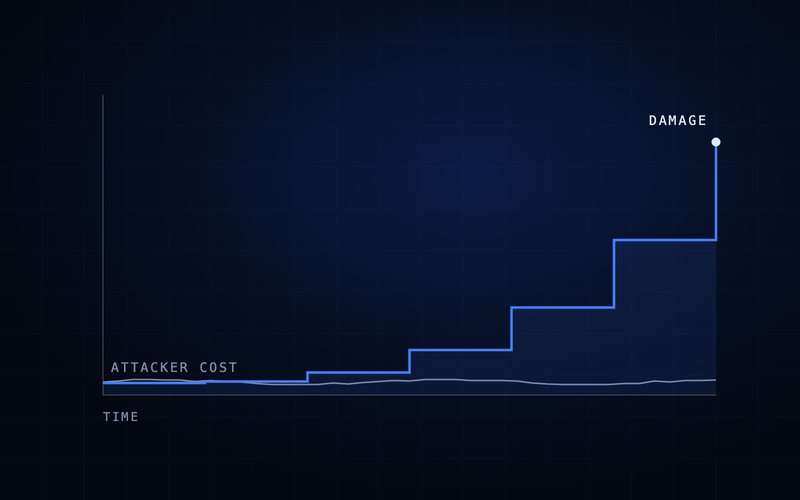
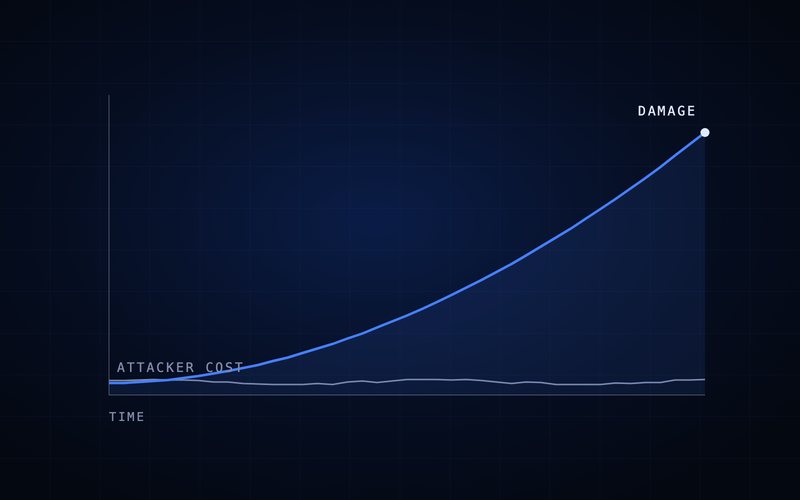
This is the asymmetry that breaks the old order: defenders pay full cost for every control they deploy, while attackers pay near-zero marginal cost for every retry. In any system where one side compounds and the other does not, the compounding side wins. Always.
The Enterprise Risk of Staying Legacy
The cost of inaction is no longer measured in patch cycles. It is measured in survival.
Incident response times that were considered industry-standard a year ago, hours, sometimes days, are now structurally incompatible with the speed of attack. Dwell time, the number of days an intruder lurks undetected, is rising even as detection budgets grow. The math is unforgiving.
Alert fatigue is silently lobotomizing security operations. When every analyst sees ten thousand alerts a shift, the real signal is statistically guaranteed to be missed. Not occasionally, systematically.
The talent shortage compounds the problem. There are not enough qualified human defenders on Earth to staff the SOCs that current models demand, and there will not be. Pretending otherwise is a budget exercise, not a strategy.
Tool sprawl creates a quieter danger: false confidence. Enterprises with thirty-plus security products believe they are well-defended. In reality, the integration gaps between those products are precisely where modern AI-driven attacks live.
And the targeting profile has shifted. AI-powered attackers are not focused exclusively on Fortune 100 enterprises with hardened perimeters. They are aggressively probing mid-market firms, regional banks, healthcare networks, manufacturers, and SMBs, organizations that historically relied on obscurity and friction for protection. Both of those defenses just collapsed simultaneously.
Boards are no longer asking "Are we protected?" They are asking: "When something breaks, how fast are we back?"
What Modern Defense Must Look Like Now
The next generation of defense is not a better dashboard. It is a different operating model.
Autonomous in detection - not waiting for a human to notice the anomaly, but identifying it the moment behavior deviates from learned baselines.
Autonomous in triage - separating noise from signal at machine speed, escalating only what humans actually need to decide.
Machine-speed containment - isolating compromised assets, revoking sessions, and severing lateral pathways within seconds, not hours.
Continuously adaptive - learning from every attempt against the perimeter, not just the successful ones, and updating defenses in real time.
AI versus AI - because no human-paced system can defend against an attacker that operates in microseconds.
Unified rather than fragmented - replacing dozens of siloed point products with a coherent autonomous fabric where signals correlate natively.
Self-learning - improving with every incident, every false positive, every novel variant. Defense, like offense, must compound.
This is not a roadmap for the next decade. This is table stakes for the next twelve months.
How Spharaka Networks Is Driving This Shift
This is the world Spharaka Networks was built for.
Spharaka Networks is a category-defining company building autonomous cyber defense infrastructure for the AI-threat era. Its flagship platform, Spharaka Sphere™, is helping enterprises make the transition from reactive security operations to machine-speed autonomous defense.
Spharaka Sphere™ delivers AI-native autonomous cyber defense across the full incident lifecycle:
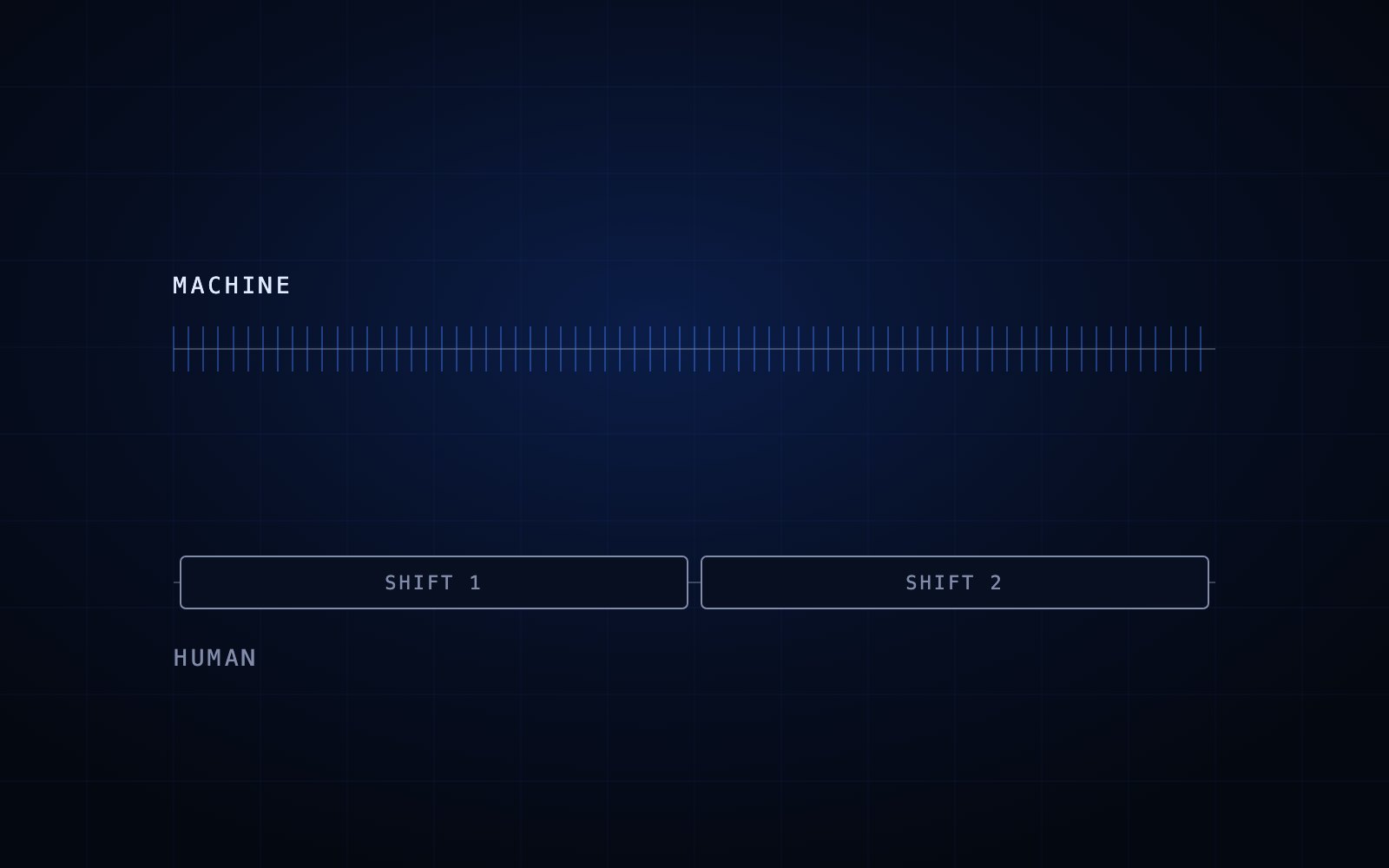
- +Real-time threat detection that operates at machine speed, not human shift cycles
- +Autonomous triage that dramatically reduces analyst overload and ends alert fatigue as a structural problem
- +Multi-agent security operations that coordinate across the attack surface the way modern adversaries do
- +Continuous adaptive learning that compounds defensive intelligence with every event
- +Faster containment and remediation that closes intrusions before they become breaches
- +Defense against AI-driven attacks using AI itself, the only credible response to the new threat model
- +Autonomous threat hunting agents that proactively pursue adversaries across the environment rather than waiting for alerts to surface
The strategic distinction matters.
While many vendors are adding AI features to architectures designed in a pre-agentic world, Spharaka Sphere™ was built as an autonomous cyber defence platform from the ground up.
Its premise is not "AI-assisted analysts." Its premise is something more fundamental:
The future is not AI-assisted security teams. The future is autonomous security systems working alongside humans, with humans elevated to oversight and strategy rather than buried under triage.
This is not an incremental improvement. It is a change in operating model, the same kind of structural shift the cloud forced on infrastructure a decade ago, now happening to security.
For enterprises facing AI-driven adversaries, the only credible answer is to defend with AI itself. Spharaka Sphere™ is that answer.
Conclusion: The Boardroom Reckoning
Boards are about to learn an uncomfortable lesson:
You cannot defend at human speed against machine-speed offense.
The SOC, as we have known it for two decades, was built for a ticketing world. The SOC was built for tickets. The future requires autonomous response. The legacy stack, the firewalls, the SIEMs, the dashboards, the rule engines, the human-in-every-loop workflows, will not disappear overnight. But its role is changing from primary defense to historical record-keeper.
Every enterprise leader now faces a binary choice.
Enterprises that modernize now gain resilience. Those that wait inherit exposure.
That exposure compounds daily as adversaries get faster, cheaper, and smarter. There is no plateau coming. There is no "we have time." The attackers have already moved to machine speed.
The only question left is whether your defense will arrive in time.
About the Author
Vishnu Nair is a Founding Member and Director of Growth and Partnerships at Spharaka Networks™. Connect on LinkedIn.
Defend at Machine Speed
See how Spharaka Sphere™ replaces human-paced security operations with autonomous, AI-native defence built for the threats of today and tomorrow.